Songs on an infinite loop due to pesky annelids

Sometime During The Last Century
Exam time. Despite preparing well, there is always an element of stress. Will the paper be easy? Will I do well? Will there be out-of-syllabus questions?
This particular exam was in the same league. The bell rang, the question paper was handed out, and we started writing. I scanned through the questions. They seemed ok. I was going to be alright. Except, I wasn’t. Somewhere mid-way through answering the paper, a song started playing in my head. Years later, I don’t remember the song. I remember it was one of those vague songs rendered by someone with a grating voice. This was not a song I’d play for my entertainment. But there it was in my head while I was bent over my exam paper.
Not knowing the whole song meant the first two lines looped in my head — for the rest of the exam. Non-stop. There was nothing I could do. I thought I had gone mad. I failed that paper. For the first time in my life, I failed to pass an exam, let alone be a topper. I must have cried buckets. The song-on-loop destroyed my confidence. I did not know it then, but I was infected with an earworm!
Only those who have suffered this will understand what I am talking about. To most people, a song looping in the head sounds fun. It is — until it doesn’t stop!
What is an Earworm?
An earworm is a song that loops in your head. This doesn’t sound like a big deal, right? It will, when it loops for hours, and is some terrible out-of-tune song.
An earworm has several pet names — stuck song syndrome (SSS), sticky music, brainworm, and intrusive musical imagery (IMI). Pick your favorite. If an earworm comes to stay, it might help to be friendly with it.
Earworms can pop up at any time. There is no clearly identifiable reason for their appearance. Once they show up, they set up their tent and camp in our ear for hours, days, even weeks.
According to Wikipedia:
Jean Harris, who murdered Herman Tarnower, was obsessed with the song “Put the Blame on Mame” by Allan Roberts and Doris Fisher, which she first heard in the film Gilda (1946). She would recall this regularly for over 33 years and could hold a conversation while playing it in her mind.
I hope the murder had nothing to do with the earworm.
A Brief History
Although earworms may be more common now because we have access to more music than in the past, there is documented evidence of the existence of earworms from long ago.
A research paper published by the University of Reading states that Edgar Allan Poe referred to an earworm in his short story, The Imp of the Perverse. The paper goes on to state that the earworm makes another appearance in Mark Twain’s short story A Literary Nightmare where he calls it a relentless jingle.
I wonder whether these literary greats wrote short stories because they were being persecuted by earworms. Would these particular stories have been longer if not for the sticky music?
What Are The Triggers?
Some songs are designed to be triggers. Musicians probably include some secret ingredient in their work to manifest earworms. This reminds me of subliminal messaging — it is hidden somewhere and our subconscious picks up on it. I guess some forms of music become loop-inducers. Think about it. You hear a snippet of a song. That snippet starts looping in your head. You cannot rest until you listen to the rest of the song — maybe in a loop throughout the day. This in turn drives up the popularity of the song. There must be some formula working in the background.
Word-based triggers
Here’s one of my triggers. I like this song — a lot. It is beautiful and the singer’s voice is powerful. Ananya Bhat hit some amazing notes in this one. For the curious minds, here’s the song:
Don’t blame me if this becomes your earworm. There are many versions of this song. But my earworm seems to favor this version.
I don’t need to hear the song to trigger my earworm. The song starts with the word ‘soju’ — that’s all I need to hear to start the incessant loop. Someone was trying to tell me about this Korean rice-based alcoholic beverage called Soju. After the first word, I was listening to them while desperately trying to switch off the song in my head.
Sometimes, a mere word can trigger the earworm because we associate the word with a song and our earworm likes that song.
Stress and fatigue
Earworms crawl in when you let down your guard — when you are at a low point. These worms are diabolical like that. They seize a weak moment when you leave a door open, and they are in!
I suspect the earworm that slithered into my head during my exam all those years ago may have been because I was already stressed about that particular exam. The sticky worm saw the door to my brain open, snuck in, and stayed for the length of the exam.
To kill a mocking earworm
There is no need to be sympathetic to earworms. Kill them as soon as possible. They sit in our heads and mock us as they play those squeaky tunes ad nauseum.
Here are a couple of tricks I use to get rid of them.
Play that song
Sometimes the solution is straightforward. If a snippet of a song is looping on and on, just play the whole song. Listen to the entire song. Let the song wash over the earworm, flood its home, and drown it completely. It may seem dumb to play the very song that is on repeat in your head, but this works for me. It takes away the ‘stuck looping 2 lines’ factor and the earworm fades way.
Press the STOP button
This one takes some creative visualization. I visualize the inside of my head. I visualize the sneaky earworm sitting there belting out the scratchy loop. Then, I visualize a big, fat, STOP button in red color!
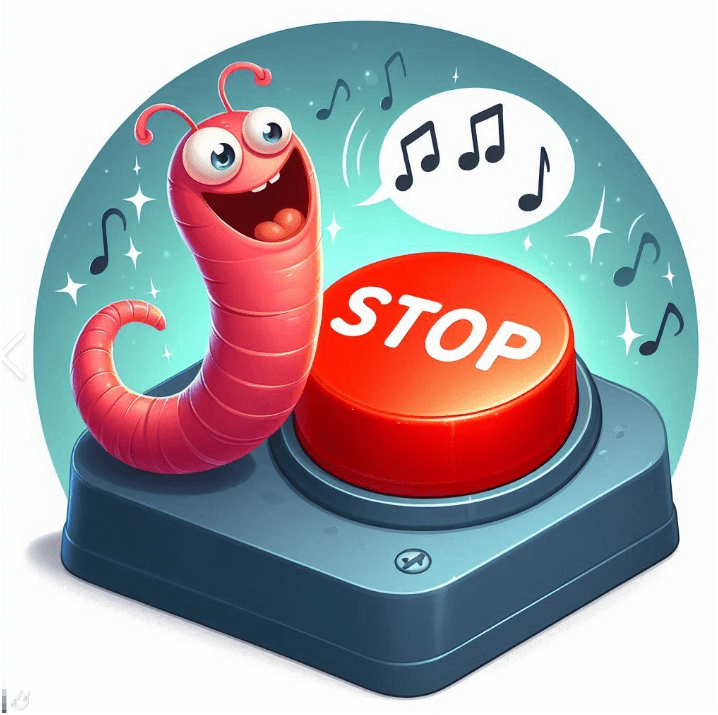
I press it. The earworm stops.
Sometimes, if I don’t press and hold the button for a bit, the earworm starts again. Then I have to press the STOP button once more.
This may sound silly, but I am telling you it works for me.
Talk over the song or play a different song
Do something to distract the darn earworm. Play a different song, engage in serious conversation with someone, or watch something interesting on TV. The goal is to take focus away from that song. Apply your mind to something deeply absorbing.
For me, the activity has to engage my brain fully. Cleaning, washing, cooking, and other such physical activities leave my brain free for the annelid to stay active.
Picking a fight with my husband, reading a few pages of a favorite book, or simply playing a different song out loud can help obliterate the earworm. Be warned though — if you play a different song, a new earworm may begin its life in your head.
Do you experience earworms too? What do you do to get rid of them? Let me know in the comments, will you?
 Anu Anniah Writes